Verification and Maintenance Closure Loop
From Implementation to Ongoing Assurance
Deploying an evidence-ready surveillance system is not the end of the journey—it is the beginning. The system must be verified to ensure it meets evidence chain requirements, and it must be maintained over time to ensure it continues to meet those requirements. This chapter addresses the verification, testing, and maintenance processes that ensure long-term evidence reliability.
The Principle: Verify, Test, and Maintain
Evidence-ready surveillance systems must be verifiable, testable, and maintainable. This means:
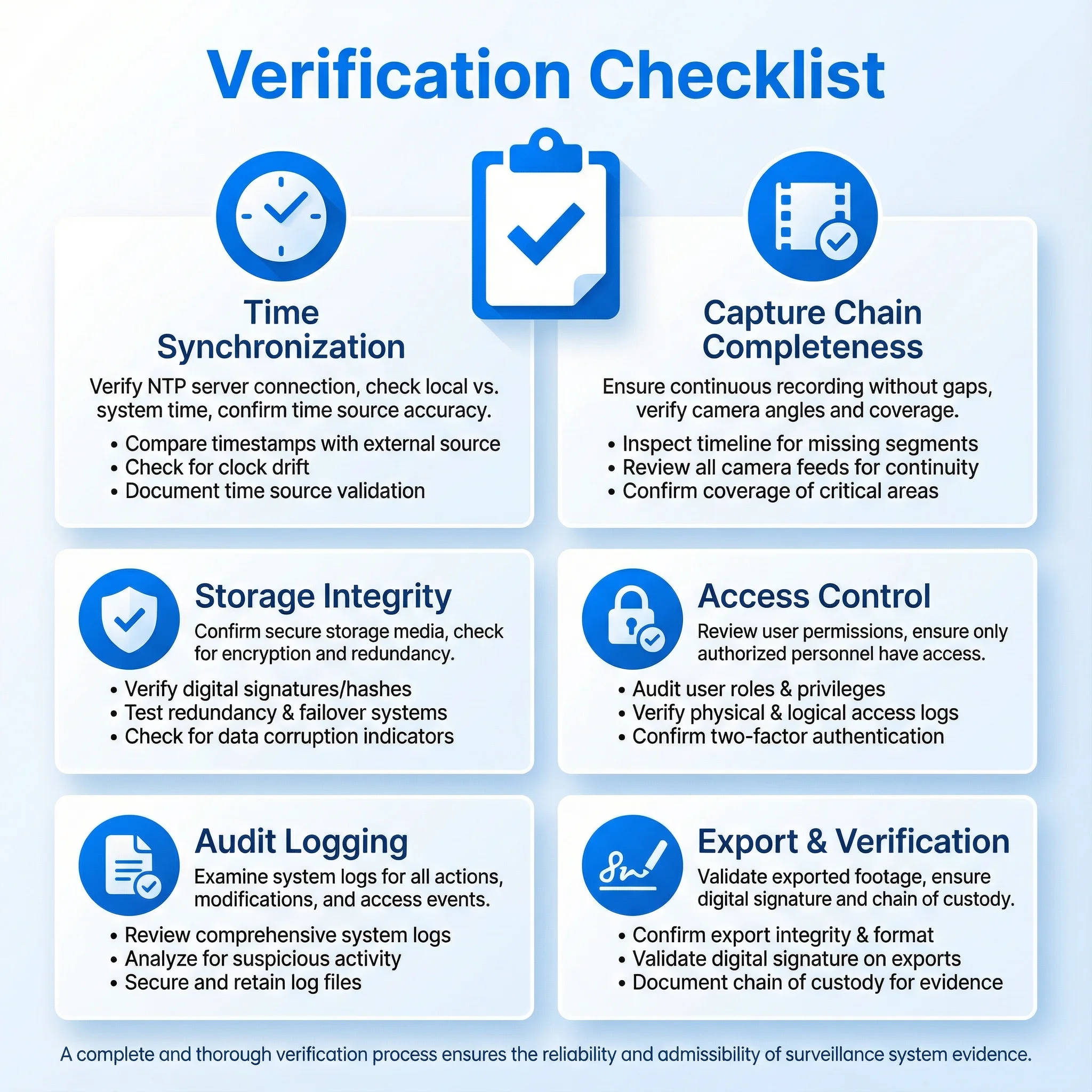
Verifiable: The system must provide mechanisms to verify that evidence chain requirements are being met. These mechanisms might include automated checks (integrity verification tools, time synchronization audits) or manual procedures (access log reviews, completeness checks). Testable: The system must support testing to ensure that evidence chain mechanisms are functioning correctly. Testing might include simulating failures (network outages, storage failures) and verifying that the system detects and responds appropriately. Maintainable: The system must be designed and operated in a way that allows ongoing maintenance and improvement. This includes regular updates, patches, and enhancements to address new threats or requirements.Verification Checklist
Before accepting a deployed surveillance system, the organization should verify that all evidence chain requirements are met. The following checklist provides a framework for this verification:
Time Synchronization Verification
- [ ] All devices are configured to synchronize with the designated NTP time server - [ ] Time synchronization is occurring at the specified interval (e.g., every 4 hours) - [ ] Time drift detection is enabled and configured with appropriate thresholds - [ ] Time drift alerts are being generated and logged - [ ] Timestamp format includes timezone information (UTC or local with timezone) - [ ] Daylight saving time handling is correctly configured - [ ] Time synchronization status can be queried and reported - [ ] Documentation of time source and accuracy specifications is available
Capture Chain Completeness Verification
- [ ] Frame numbers are present in all video streams - [ ] Frame numbers increment continuously without gaps - [ ] Missing frame detection is enabled and functioning - [ ] Missing frames are logged with timestamp and camera identity - [ ] Completeness verification tools are available and functional - [ ] Completeness verification can be performed on stored footage - [ ] Completeness verification can be performed on exported footage - [ ] Sample footage has been verified for completeness
Storage Integrity Verification
- [ ] Checksums are calculated for all stored footage - [ ] Checksums are stored separately from the footage - [ ] Checksum algorithm is documented (SHA-256 or equivalent) - [ ] Integrity verification is performed at specified intervals (e.g., monthly) - [ ] Integrity verification failures generate alerts - [ ] Integrity verification failures are logged - [ ] Integrity verification tools are available and functional - [ ] Sample footage has been verified for integrity
Access Control Verification
- [ ] Role-based access control is implemented with defined roles - [ ] Users are assigned to appropriate roles based on job responsibilities - [ ] Multi-factor authentication is enabled - [ ] Access control is enforced at the application level - [ ] Access control is enforced at the storage system level - [ ] Access control policies are documented - [ ] Access control can be tested and verified
Audit Logging Verification
- [ ] Audit logging is enabled for all access to footage - [ ] Audit logs record user identity, timestamp, footage accessed, and actions taken - [ ] Audit logs are stored separately from the footage - [ ] Audit logs are protected against modification - [ ] Audit logs are backed up regularly - [ ] Audit logs can be exported for review - [ ] Audit logs can be searched and analyzed - [ ] Sample audit logs have been reviewed for completeness and accuracy
Export and Verification Verification
- [ ] Exported files include comprehensive metadata - [ ] Exported files include digital signatures or checksums - [ ] Verification tools are available for exported files - [ ] Verification tools can be used independently of the surveillance system - [ ] Chain of custody documentation is generated with exports - [ ] Sample exported files have been verified for authenticity - [ ] Exported files can be verified by parties outside the organization
Testing and Validation Procedures
After verification, the system should be tested to ensure that evidence chain mechanisms function correctly under various conditions. The following procedures provide a framework for comprehensive testing:
Time Synchronization Testing
Objective: Verify that time synchronization is accurate and that time drift is detected. Procedure:1. Deliberately set one device's time to an incorrect value (e.g., 1 hour ahead) 2. Observe whether the system detects the time drift 3. Verify that an alert is generated 4. Verify that the alert is logged 5. Correct the device's time 6. Verify that the system returns to normal operation
Success Criteria: Time drift is detected within the specified threshold time (e.g., 5 minutes), an alert is generated, and the alert is logged.Capture Chain Completeness Testing
Objective: Verify that missing frames are detected and logged. Procedure:1. Simulate a network outage that causes packet loss 2. Observe whether the system detects missing frames 3. Verify that missing frames are logged 4. Verify that an alert is generated (if configured) 5. Restore network connectivity 6. Verify that frame capture resumes normally
Success Criteria: Missing frames are detected, logged, and reported within the specified time.Storage Integrity Testing
Objective: Verify that integrity verification detects modifications to stored footage. Procedure:1. Store a sample video file 2. Calculate and record the checksum 3. Deliberately modify a few bytes of the stored file 4. Run integrity verification 5. Verify that the integrity verification detects the modification 6. Verify that an alert is generated 7. Restore the original file from backup 8. Verify that integrity verification passes
Success Criteria: Integrity verification detects the modification, generates an alert, and logs the event.Access Control Testing
Objective: Verify that access control prevents unauthorized access. Procedure:1. Create a test user with the "Viewer" role 2. Attempt to access footage as the test user 3. Verify that the user can view footage 4. Attempt to export footage as the test user 5. Verify that the export is denied 6. Attempt to delete footage as the test user 7. Verify that the deletion is denied 8. Create a test user with the "Evidence Officer" role 9. Attempt to export footage as the test user 10. Verify that the export is allowed
Success Criteria: Access control correctly enforces role-based permissions.Audit Logging Testing
Objective: Verify that all access is logged and that audit logs are protected. Procedure:1. Perform a series of actions (view footage, search, export) 2. Review audit logs 3. Verify that all actions are logged 4. Verify that audit logs include user identity, timestamp, and action details 5. Attempt to modify an audit log entry 6. Verify that the modification is prevented or detected 7. Attempt to delete an audit log entry 8. Verify that the deletion is prevented or detected
Success Criteria: All actions are logged, audit logs are complete and accurate, and audit logs are protected against modification.Export and Verification Testing
Objective: Verify that exported files can be verified as authentic. Procedure:1. Export a sample video file 2. Verify that the exported file includes metadata 3. Verify that the exported file includes a checksum or digital signature 4. Use verification tools to verify the exported file 5. Deliberately modify the exported file 6. Use verification tools to detect the modification 7. Verify that the modification is detected
Success Criteria: Exported files include verification information, verification tools can verify authenticity, and modifications are detected.Operational Maintenance Procedures
Once the system is deployed and tested, ongoing maintenance procedures ensure that evidence chain requirements continue to be met:
Monthly Procedures
Time Synchronization Audit: Verify that all devices are synchronized within acceptable limits. Check that time drift detection is functioning. Investigate any devices with excessive drift. Integrity Verification: Run integrity verification tools on a sample of stored footage. Investigate any integrity failures. Access Log Review: Review access logs for unusual patterns or unauthorized access attempts. Investigate any suspicious activity. Backup Verification: Verify that backup copies are being created and are intact. Test backup restoration to ensure backups can be recovered if needed.Quarterly Procedures
Completeness Verification: Run completeness verification tools on footage from each camera. Investigate any completeness failures. Access Control Review: Review user access to ensure that users have only the permissions they need. Remove access for users who have left the organization or changed roles. Audit Log Analysis: Analyze audit logs for patterns or trends. Identify any unusual access patterns or potential security issues. System Performance Review: Review system performance metrics (storage usage, bandwidth utilization, processing load). Identify any performance issues or capacity concerns.Annual Procedures
Comprehensive System Audit: Perform a comprehensive audit of the entire surveillance system. Verify that all evidence chain requirements are being met. Identify any gaps or deficiencies. Security Assessment: Perform a security assessment to identify any vulnerabilities or risks. Address any identified issues. Compliance Review: Review compliance with relevant legal and regulatory standards. Ensure that the system continues to meet compliance requirements. Training Refresh: Provide refresher training to personnel who interact with the surveillance system. Update training materials to reflect any system changes or new procedures. Disaster Recovery Testing: Test the disaster recovery procedures to ensure that the system can be recovered if a disaster occurs. Verify that backups are complete and can be restored.Incident Response Procedures
When an incident occurs that affects evidence chain integrity, the organization must respond promptly and document the incident:
Integrity Failure Response
When an integrity verification fails (checksum mismatch):1. Immediately isolate the affected footage from further access 2. Preserve the affected footage for forensic analysis 3. Investigate the cause of the failure 4. Determine whether the failure indicates actual tampering or a system error 5. Document the failure, investigation, and findings 6. If tampering is suspected, involve law enforcement or security personnel 7. Review access logs to determine who had access to the affected footage 8. Implement corrective measures to prevent future failures
Unauthorized Access Response
When unauthorized access is detected:1. Immediately revoke the unauthorized user's access 2. Preserve audit logs related to the unauthorized access 3. Investigate the cause of the unauthorized access 4. Determine what footage was accessed and what actions were taken 5. Document the incident, investigation, and findings 6. Review access control policies and procedures 7. Implement corrective measures to prevent future unauthorized access 8. Notify affected parties if necessary (depending on the nature of the unauthorized access)
Time Synchronization Failure Response
When time synchronization fails:1. Investigate the cause of the failure 2. Determine how long the failure lasted 3. Assess whether footage captured during the failure has reliable timestamps 4. Document the failure, duration, and impact on evidence chain 5. Correct the time synchronization issue 6. Verify that time synchronization has been restored 7. Review footage captured during the failure period to assess timestamp reliability 8. If timestamp reliability is questionable, flag the affected footage as potentially unreliable
Responsibility Matrix
Clear assignment of responsibilities ensures that verification and maintenance procedures are performed consistently:
| Procedure | Responsibility | Frequency | Escalation | |-----------|----------------|-----------|-----------| | Time Synchronization Audit | System Administrator | Monthly | IT Manager if issues found | | Integrity Verification | System Administrator | Monthly | IT Manager if failures detected | | Access Log Review | Security Officer | Monthly | Chief Security Officer if issues found | | Backup Verification | IT Operations | Monthly | IT Manager if backups fail | | Completeness Verification | System Administrator | Quarterly | IT Manager if failures detected | | Access Control Review | Security Officer | Quarterly | Chief Security Officer if issues found | | Audit Log Analysis | Security Officer | Quarterly | Chief Security Officer if issues found | | System Performance Review | System Administrator | Quarterly | IT Manager if issues found | | Comprehensive System Audit | IT Manager | Annually | CIO if major issues found | | Security Assessment | Security Officer | Annually | Chief Security Officer if vulnerabilities found | | Compliance Review | Legal/Compliance | Annually | General Counsel if non-compliance found | | Training Refresh | Training Coordinator | Annually | HR if training incomplete | | Disaster Recovery Testing | IT Operations | Annually | IT Manager if recovery fails |
Documentation and Record Keeping
All verification, testing, and maintenance activities must be documented:
Verification Records: Document the results of the initial verification checklist. Record any issues found and how they were resolved. Testing Records: Document the results of all testing procedures. Record test dates, procedures performed, results, and any issues found. Maintenance Records: Document all maintenance activities. Record the date, procedure performed, results, and any issues found. Incident Records: Document all incidents affecting evidence chain integrity. Record the incident date, description, investigation findings, and corrective actions taken. Audit Records: Document all audit activities. Record audit dates, procedures performed, findings, and recommendations.These records serve multiple purposes: - They provide evidence that the system is being properly maintained - They help identify patterns or recurring issues - They support regulatory compliance and audit requirements - They provide a history of system changes and improvements
Continuous Improvement
The verification and maintenance process should include continuous improvement. Based on testing results, incident investigations, and audit findings, the organization should identify opportunities to improve the system:
Process Improvements: Identify ways to make verification and maintenance procedures more efficient or effective. System Improvements: Identify ways to enhance the surveillance system to better meet evidence chain requirements. Training Improvements: Identify ways to improve training and awareness among personnel who interact with the system. Policy Improvements: Identify ways to improve policies and procedures related to evidence handling.Conclusion
Verification and maintenance are not one-time activities but ongoing processes. An evidence-ready surveillance system requires continuous monitoring, testing, and improvement to ensure that it continues to meet evidence chain requirements over time. Organizations that implement comprehensive verification and maintenance procedures can have confidence that their surveillance systems are reliable evidence platforms.
The investment in verification and maintenance is justified by the value of reliable evidence. An organization that can confidently present surveillance footage as evidence gains significant advantages in disputes, investigations, audits, and legal proceedings. The cost of verification and maintenance is far less than the cost of evidence chain failures.